
A few weeks ago, Luciana and I sat down to prep for her internship — talking through catastrophe analytics, risk modeling, and how AI is reshaping the way modern teams work. Last time I wrote, I shared how that conversation made me rethink just how far our tools have come.
Now we’re here. She’s stepping into the real thing. And I’m watching it all with a mix of pride, nostalgia, and a very real sense of how fast the world has changed.
The First Time I Walked Into the Corporate World
Thirty years ago, I walked into PetroPerú as an intern — my first real shot at the corporate world. The setup was peak mid‑90s: FoxPro screens, powering the reporting workflows for la maestra financiera.

Everything ran off those blue‑and‑gray DOS windows, and every report we built eventually made its way to an inkjet printer that hummed like it was doing heavy industrial work. You’d send a job, hear the slow mechanical buzz, and watch each page come out like it was being negotiated with the machine.
I was trying to figure out how all of it worked — the data structures, the scripts, the printing queues, the way FoxPro stitched everything together. Back then, the data didn’t just “arrive” in your workflow. It came down from a mainframe through a BNC network card plugged into an IBM PC — a thick coax cable carrying batches of financial records that FoxPro would parse and turn into reports.
And I’ll never forget one detail: they gave me one of the first monitors with auto‑standby mode. Everyone else’s screens stayed on all day, glowing like a row of tiny suns. Mine was the only one that went dark on its own. It felt futuristic — like I had a small piece of tomorrow sitting on my desk.
While I’m Reinventing Myself, Luciana’s Generation Is Beginning Where Reinvention Is the Norm
Fast‑forward to now, and the landscape my daughter is stepping into moves at a completely different speed. I’m reinventing myself on the fly — learning new tools, new workflows, new AI patterns — and making constant reinvention the norm. The pace isn’t just fast; it’s continuous. You don’t “catch up.” You stay in motion.
But what really strikes me is how natural this feels to Luciana.
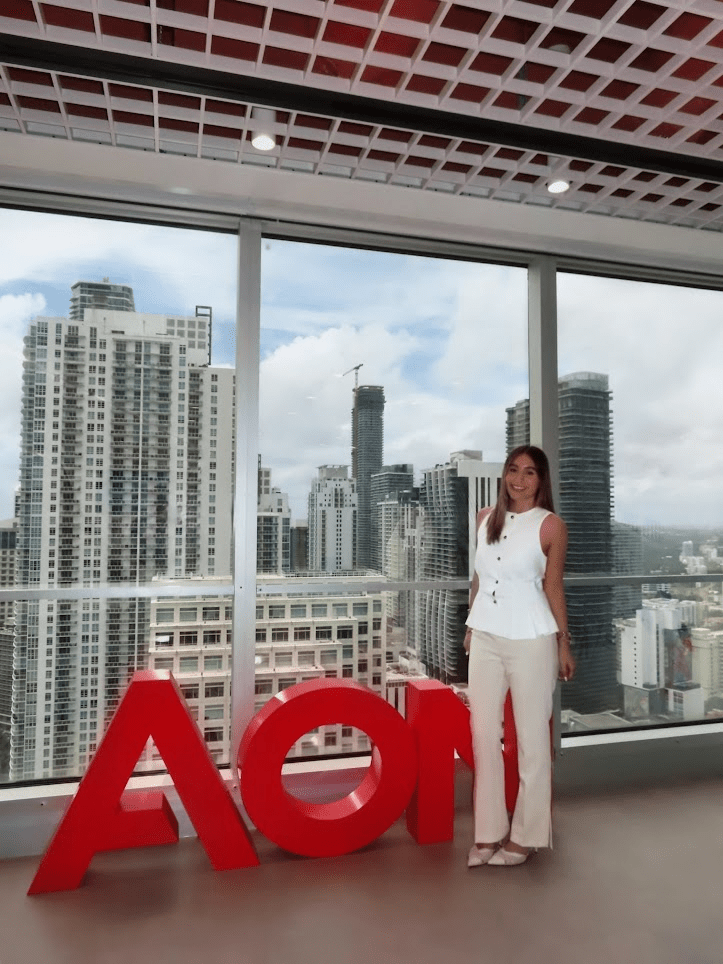
She completed her internship at Aon in catastrophe analytics — risk modeling, AI‑first delivery, collaborating with peers and seasoned experts right in the heart of Brickell. And she stepped into all of it as if this was simply how work has always been. No hesitation. No surprise. No adjustment period.
For her generation, this acceleration isn’t a shock. It’s the baseline. They’re hitting the road already tuned to these dynamics.
Luciana and her cohort don’t see rapid learning, constant adaptation, and AI‑driven execution as “new.” They see it as the starting point. They’re entering a corporate world where learning fast, adapting fast, and building fast isn’t a special skill — it’s the default operating mode.
Why This Matters for Students Finishing College
For anyone finishing college right now, the corporate world they’re stepping into is nothing like the one I entered. The tools are smarter. The expectations are higher. The cycles of change are shorter.
But the opportunity is bigger.
You get one moment early in your career where everything is new, everything is possible, and everything you learn becomes the foundation for what comes next. And today’s students have access to technology that can multiply their impact from day one — if they embrace it.
Luciana is stepping into that moment with the right mindset and the right tools. And organizations like Aon are giving her — and her generation — a runway to experiment, build, and deliver in ways that weren’t imaginable 30 years ago.
I’m proud of her. I’m inspired by her. And I’m reminded that reinvention isn’t just something we do mid‑career — it’s something this new generation is born into.
The best is ahead.